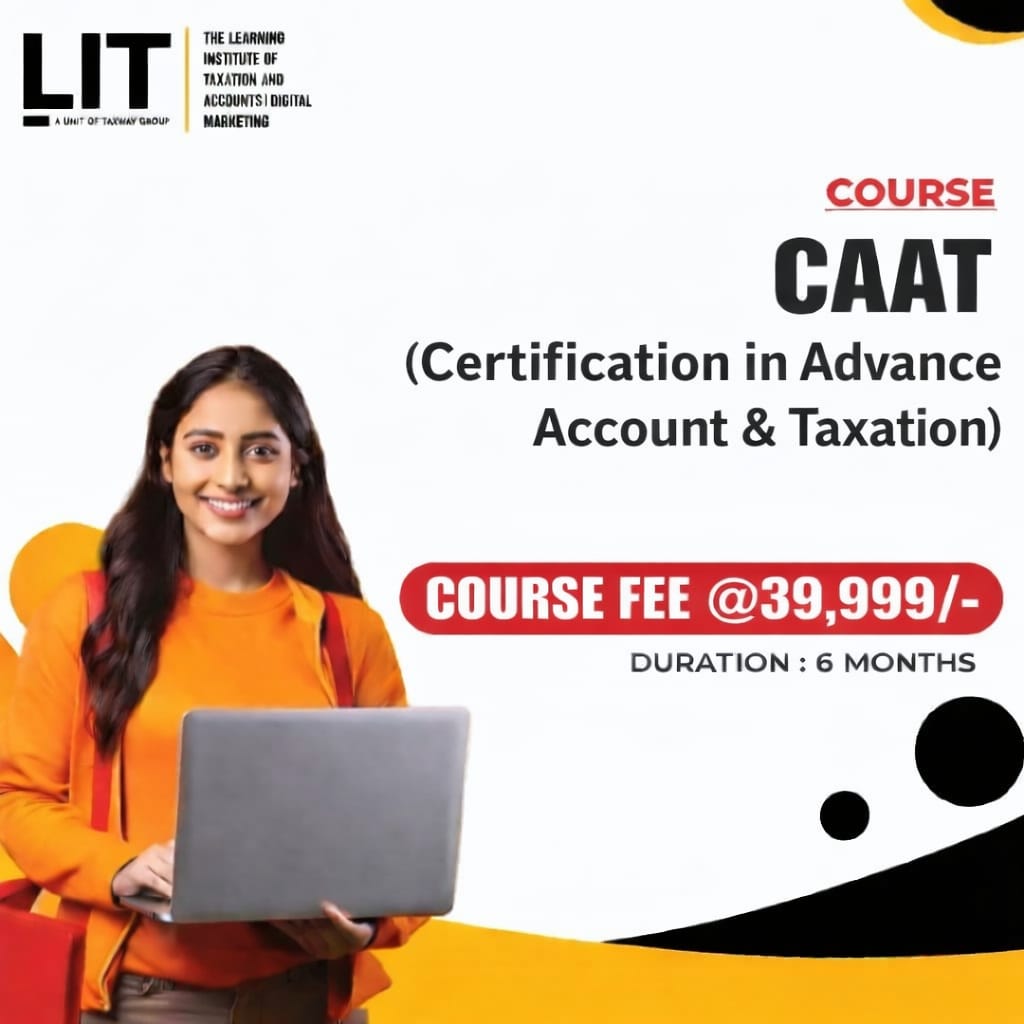
CAAT (Certificate in Advance Accountant & Taxation)

- Description
- Curriculum
- FAQ
- Notice
- Reviews
Advanced Accounting, Taxation, and Business Management Syllabus
The provided documents detail several professional certification programs offered by the Taxway Group, specifically the Certificate in Advanced Accountant & Taxation (CAAT), Business Accountant, and Tax Practitioner courses. These programs provide a deep exploration of financial accounting, applied commercial laws, and statutory compliance, including detailed training on GST, Income Tax, and Customs. Students gain practical proficiency in essential business tools like Tally-ERP 9, SAP, and Microsoft Office, alongside modern topics such as AI in accounting and forensic investigation. The curriculum also extends to diverse business operations, covering company registration, intellectual property, loan management, and digital marketing strategies. Ultimately, these courses are designed to equip learners with the technical expertise and soft skills necessary for careers in modern finance and consultancy.
The programs detailed in the sources cover a comprehensive and diverse range of legal and statutory compliance skills, preparing students for practical corporate and financial administration. The skills are broadly categorized into industrial, commercial, corporate, and taxation laws, alongside specific licensing and regulatory frameworks.
Based on the provided sources, the core differences between the CAAT (Certificate in Advanced Accountant & Taxation) and the Tax Practitioner courses lie in their scope, practical focus, and specialized modules:
1. Scope of the Curriculum (Breadth vs. Specialization)
- CAAT Course: This is a broad, foundational program (6 months) covering the entire spectrum of financial accounting, including the preparation of final accounts, depreciation, payroll accounting, and costing principles. It also provides a wide overview of taxation (GST, Customs, and Income Tax).
- Tax Practitioner Course: This program is highly specialized and intensely focused on the advanced, practical application of tax laws. It skips the foundational accounting principles to focus on specific tax elements like anti-profiteering measures, residential status, and the scope of total income.
2. Legal and Industrial Training
- CAAT Course: Includes extensive modules on both Applied Commercial Laws (such as the Laws of Contracts, Sale of Goods, and Partnership Act) and Industrial Laws (such as the Factories Act, Minimum Wages Act, Provident Fund Act, and Payment of Bonus Act).
- Tax Practitioner Course: Does not focus on general corporate or labor laws, strictly prioritizing tax legislation and keeping up with changes in tax laws.
3. Software and Technology Focus
- CAAT Course: Trains students on general business and accounting software, featuring a 25-hour SAP End User Program, Tally-ERP 9, and Microsoft Office applications. It does include a 20-hour e-filing module.
- Tax Practitioner Course: Features dedicated hands-on practice sessions specifically for using tax filing software and conducting mock filing of returns.
4. Professional Development and Training Approach
- CAAT Course: Incorporates a 20-hour module dedicated to “Generic Skills for Employability,” which covers communication skills, financial literacy, and self-management.
- Tax Practitioner Course: Focuses on immersive industry exposure through real-world case studies, problem-solving of real-world scenarios, guest lectures from industry experts, and interactive Q&A workshops.
Here is a detailed breakdown of the compliance skills and topics covered:
1. Industrial and Labor Law Compliance The courses provide extensive training on managing employee-related statutory obligations, which is critical for payroll and HR accounting. Skills include:
- Applying Key Labor Acts: Understanding the scope and applicability of the Factories Act (1948), Payment of Wages Act (1936), and Minimum Wages Act (1948).
- Managing Employee Benefits: Administering compliance for the Provident Fund (PF) Act, ESI Act (1948), Payment of Bonus Act, and Payment of Gratuity Act.
- Payroll Deductions: Practical execution of payroll accounting, focusing heavily on calculating and managing statutory deductions such as EPF, ESI, Income Tax, and Professional Tax.
2. Taxation Laws and Practical E-Filing A core component of these programs is statutory tax compliance, covering both direct and indirect taxes:
- Direct Taxation (Income Tax): Calculating total income, understanding residential status, tax liabilities, assessing exemptions (such as under Chapter VI-A), managing TDS (Tax Deducted at Source) and TCS (Tax Collected at Source), and navigating appeals and revisions.
- Indirect Taxation (GST and Customs): Detailed compliance regarding the Goods and Services Tax (CGST, SGST, IGST), determining the time and value of supply, claiming and reversing Input Tax Credit, and handling GST registration and tax invoicing. The curriculum also covers customs duty management, including import/export procedures, anti-dumping duties, and refunds.
- E-Filing Mastery: Practical skills in the online filing of Income Tax returns, GST returns, Customs duties, ESIC, and PF returns, as well as obtaining and using Digital Signatures. The Tax Practitioner program specifically features hands-on mock filing sessions and the use of tax filing software.
3. Corporate, Commercial, and Auditing Laws Students are trained to navigate the legal foundations of business operations and corporate governance:
- Commercial Law Foundations: Grasping the essential elements of the Laws of Contracts (including void agreements and capacity of parties), Laws relating to Sale of Goods, and the Partnership Act.
- Company Incorporation and ROC Compliance: Managing the end-to-end legal framework under the Companies Act, 2013. This includes step-by-step company registration (Private, Public, LLP), maintaining statutory registers, filing annual returns with the Registrar of Companies (ROC), and understanding the penalties for non-compliance.
- Statutory and Compliance Auditing: Planning and conducting internal, external, and statutory audits according to specific auditing standards (SA, AAS). It also touches on forensic accounting to detect financial frauds like embezzlement and money laundering.
4. Intellectual Property (IP) and Industry Licensing The syllabus extends beyond traditional accounting to include business protection and operational licensing:
- IP Protection: Navigating the Trademark Act (1999) and Copyright Act (1957). Skills include managing registration processes, handling infringements, understanding legal remedies, and dealing with international protections like the WIPO.
- Food Licensing (FSSAI): Understanding the Food Safety and Standards Act (2006), managing Food Safety Management Systems (FSMS), and handling post-licensing compliance like annual returns and labeling regulations.
- ISO Certification: Preparing organizations for quality and security audits under standards like ISO 9001, ISO 14001, and ISO 27001.
5. Banking and Securities Regulation For those dealing with financial markets and institutions, the programs outline critical regulatory frameworks:
- Banking Compliance: Understanding the RBI Act, Banking Regulation Act, and Basel Norms, alongside managing banking risks.
- Stock Market Regulations: Navigating SEBI Guidelines, insider trading laws, and the taxation of stock market transactions.
By blending theoretical legal knowledge with practical modules like e-filing and case studies, these programs aim to ensure professionals can successfully manage the full spectrum of legal, tax, and regulatory compliance required in a modern business environment.


Productivity Hacks to Get More Done in 2018
— 28 February 2017
- Facebook News Feed Eradicator (free chrome extension) Stay focused by removing your Facebook newsfeed and replacing it with an inspirational quote. Disable the tool anytime you want to see what friends are up to!
- Hide My Inbox (free chrome extension for Gmail) Stay focused by hiding your inbox. Click "show your inbox" at a scheduled time and batch processs everything one go.
- Habitica (free mobile + web app) Gamify your to do list. Treat your life like a game and earn gold goins for getting stuff done!